
The Ultimate Vertical Integration: How Elon Musk Bought the Socket and Rewrote the Rules of the AI Race.
Forget GPUs and parameter counts. The real war for AGI is being fought over raw megawatts—and xAI just bypassed the global grid to build a sovereign energy empire.

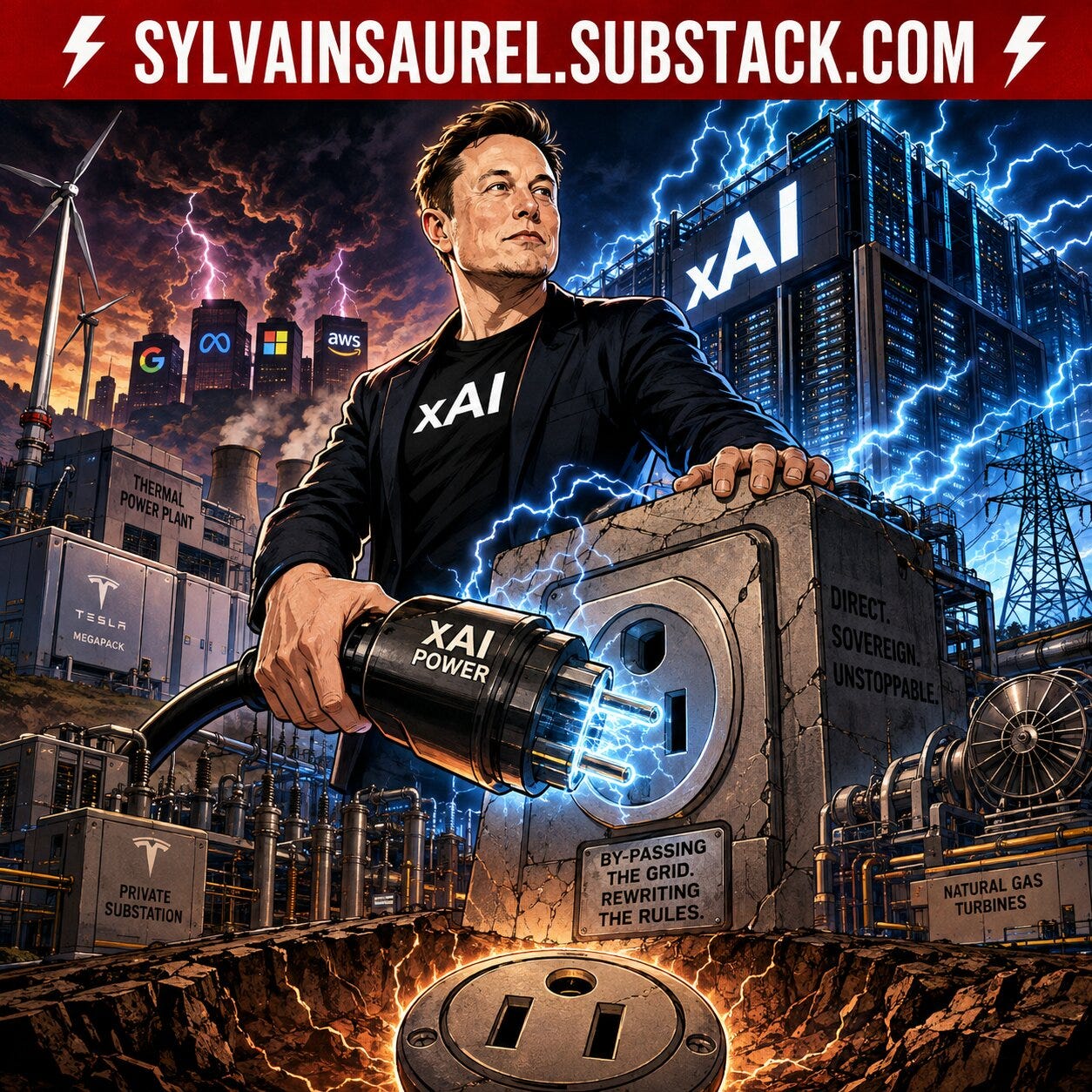
In the frenetic, multi-trillion-dollar arms race to build Artificial General Intelligence (AGI), the public narrative has been dominated by a singular obsession: silicon. We track the release of every new generation of NVIDIA hardware, debate the intricacies of model parameters, and theorize about algorithmic breakthroughs. We watch as tech titans pour billions into securing the latest GPUs, treating them as the modern era’s most precious commodity.
But beneath the surface of this silicon rush, a quiet and profound paradigm shift has just occurred. Elon Musk, through his artificial intelligence venture xAI, has just added an entirely new, deeply physical layer to his AI stack. It is a move so audacious, and so vastly outside the traditional playbook of Silicon Valley, that almost nobody is talking about it.
To understand the magnitude of this shift, you have to understand the traditional architecture of an AI company. Most people building artificial intelligence rent three fundamental things:
Chips: The computational brains (typically from NVIDIA, AMD, or bespoke silicon).
Data Centers: The physical structures that house the servers, cooling systems, and networking gear.
Power: The electricity drawn from the local municipal or regional utility grid.
Musk’s xAI has already secured the first two pillars. It buys NVIDIA’s chips in massive quantities and has transitioned to building its own colossal data centers, rather than relying on the cloud infrastructure of Amazon Web Services (AWS), Microsoft Azure, or Google Cloud.
But in 2025, xAI slammed into the same invisible wall that every other major player in the artificial intelligence sector is hitting right now: There simply is not enough electricity coming out of the grid to run these machines.
While most companies are resigning themselves to waiting years for power companies to upgrade transmission lines and catch up to the demand, Musk made a radically different decision. He decided to stop renting the grid. He decided to start buying the power layer itself.
This is the story of how Elon Musk is vertically integrating downward—from algorithms, to chips, to data centers, all the way to owning the raw electricity generation itself. In the AI race, everyone is obsessing over models and chips. Musk has figured out that the real bottleneck is power. And he just bought the socket.
The Silicon Standard: How NVIDIA GPUs Became the 21st Century's Most Powerful Financial Asset Class.

The global financial system has historically oriented itself around a handful of universally recognized asset classes. For centuries, physical commodities like gold, silver, and oil dictated the flow of capital. In the modern era, real estate, sovereign debt, and corporate equities formed the bedrock of institutional portfolios. But economic paradigms shift when technological revolutions demand it.
Chapter 1: The Three Pillars of Artificial Intelligence
To fully grasp the ingenuity of Musk’s strategy, we must first dissect the current state of the artificial intelligence supply chain. The development of foundational AI models—like OpenAI’s GPT series, Google’s Gemini, or xAI’s Grok—requires an ungodly amount of computation. This computation is not a nebulous, ethereal concept; it is intensely physical.
Pillar 1: The Silicon
For the past decade, the tech industry has been engaged in a brutal war of attrition to secure GPUs (Graphics Processing Units). NVIDIA, the undisputed king of this domain, has seen its valuation skyrocket to historic highs because it manufactures the picks and shovels for the AI gold rush. Securing allocations of H100s, B200s, and future generations of silicon has been the primary constraint on AI development. If you didn’t have the chips, you couldn’t train the model. For a long time, compute was the bottleneck.
Pillar 2: The Physical Infrastructure
Once a company acquires the chips, they need a place to put them. Traditionally, AI labs rented space and compute from hyperscalers like Microsoft, Amazon, and Google. But as models grew larger, the economics shifted. Renting became prohibitively expensive, and the physical constraints of traditional data centers—which were built for cloud computing, not AI—became apparent.
AI data centers require a completely different architecture. The servers are incredibly dense, generating immense amounts of heat that require advanced liquid cooling solutions rather than traditional forced-air HVAC systems. Recognizing this, xAI began aggressively building its own bespoke data centers, optimized specifically for the high-density networking and thermal dynamics of massive GPU clusters.
Pillar 3: The Energy
This brings us to the final, and currently most critical, pillar: electricity. You can have 100,000 state-of-the-art GPUs sitting in a custom-built, liquid-cooled facility. But if you cannot plug them into a reliable, massive source of power, you own nothing but a very expensive, very quiet warehouse of silicon.
For the entire history of the tech industry, power has been treated as a given. Software engineers and tech executives rarely concerned themselves with the physics of electricity generation. They assumed that if they built a data center, the local utility would simply run a wire to it and send them a monthly bill. They treated the power grid as an infinite, on-demand resource.
That illusion has violently shattered.
Bitcoin Has No Leaders. So Who Just Fired Luke Dashjr?

The removal of one of Bitcoin’s longest-serving developers from the BIP editorial team has exposed an uncomfortable truth: Bitcoin may have no rulers, but it still has power.
Chapter 2: The Great Compute Starvation and the Grid Lock
Why is the grid failing Big Tech? The answer lies in the staggering, unprecedented energy density of modern AI hardware, coupled with the antiquated, slow-moving nature of electrical infrastructure.
The Math of Massive Compute
Let’s look at the raw numbers. A traditional data center rack, housing standard servers for web hosting or enterprise software, typically consumes between 5 and 10 kilowatts (kW) of power. A modern AI rack, packed tightly with NVIDIA’s latest enterprise GPUs, can consume upwards of 100 to 120 kW per rack.
When you scale this up to the sizes required to train next-generation foundational models, the numbers become geopolitical in scale. A cluster of 100,000 next-generation GPUs requires hundreds of megawatts (MW) just to power the chips. When you factor in the Power Usage Effectiveness (PUE)—the overhead required to cool the chips and run the networking equipment—a massive AI data center can easily demand 1 gigawatt (GW) or more of continuous, uninterrupted power.
To put 1 gigawatt into perspective:
It is the equivalent of the power drawn by roughly 750,000 typical American homes.
It requires the entire output of a standard commercial nuclear reactor.
It requires essentially a minor city’s worth of electrical infrastructure dedicated to a single, monolithic building.
The Interconnection Queue Crisis
The United States power grid—a patchwork of regional transmission organizations, aging infrastructure, and heavy regulatory oversight—was simply not designed for gigawatt-scale point loads appearing overnight.
When a tech company approaches a utility and asks for 1GW of power for a new data center, the utility cannot simply flip a switch. They have to conduct massive grid impact studies. They often need to build new high-voltage transmission lines, construct massive new substations, and procure industrial-grade transformers.
Currently, the supply chain for high-voltage transformers is severely constrained, with wait times stretching up to 3 or 4 years. Furthermore, the regulatory process for permitting new transmission lines (dealing with local zoning laws, environmental impact reports, and public utility commissions) is notoriously glacial.
As a result, tech companies are finding themselves trapped in what is known as the “interconnection queue.” Across the United States, there are hundreds of gigawatts of requested power waiting for approval and infrastructure upgrades. For a tech company moving at the breakneck speed of the AI race, where a six-month delay can mean the difference between market dominance and obsolescence, being told to “wait four years for the grid to catch up” is a death sentence.
The Immutable Monolith: Why NVIDIA Must Add JPMorgan to Achieve "Z-Level" Financial Security.

The technology sector is no longer merely a subset of the global economy; it is rapidly becoming the foundational infrastructure upon which the entire future of human enterprise is built. At the bleeding edge of this paradigm shift sits NVIDIA (NVDA), a company that has evolved from a niche graphics card manufacturer into the singular architect of the Artificial Intelligence revolution. Under the visionary leadership of Jensen Huang, NVIDIA has achieved a market dominance so absolute that its silicon is now treated as a quasi-sovereign asset.
Chapter 3: The Traditional Playbook vs. Extreme Vertical Integration
Faced with this grid lock, the traditional tech giants—Microsoft, Alphabet, Amazon, and Meta—have largely defaulted to their standard corporate playbooks.
The Big Tech Waiting Game
The traditional approach involves heavy lobbying, long-term Power Purchase Agreements (PPAs), and a reliance on the existing system.
Microsoft has aggressively pursued nuclear energy, famously signing a deal to revive a reactor at Three Mile Island to power its data centers. However, this is a long-term play; the regulatory hurdles to bring nuclear power online are immense, and the timelines stretch into the late 2020s or 2030s.
Amazon (AWS) purchased a data center campus directly adjacent to the Susquehanna nuclear power plant in Pennsylvania, a clever move to secure “behind-the-meter” power. Yet, they still face intense regulatory scrutiny from the Federal Energy Regulatory Commission (FERC) over grid stability concerns.
Google continues to invest heavily in wind, solar, and advanced geothermal projects, but these intermittent power sources require massive battery storage to provide the 24/7 baseload power that AI training demands.
All of these companies are fundamentally playing the same game: they are trying to coax, incentivize, or partner with the existing heavily regulated utility industry to solve their power problems. They are waiting.
The Musk Philosophy: First Principles and Raw Control
Elon Musk does not wait. Across his entire career, his response to supply chain bottlenecks and systemic inefficiencies has been a philosophy of extreme vertical integration, driven by first-principles thinking.
When SpaceX realized that buying rockets from legacy aerospace companies like United Launch Alliance (ULA) was too expensive and slow, they didn’t just design their own rockets—they built the factory to manufacture the components, going so far as to build their own friction-stir welding machines and write their own avionics software.
When Tesla realized that the global supply of lithium-ion batteries would not support mass-market electric vehicles, they didn’t wait for Panasonic or LG to build more factories. They partnered to build the Gigafactory, integrating the supply chain from raw materials down to the battery pack.
Now, apply this same philosophy to xAI. Musk looked at the AI supply chain. He secured the chips. He designed the data centers. He hit the power bottleneck. Instead of forming a lobbying committee to beg utility regulators for a faster interconnection queue, he asked a fundamental question:
What is stopping us from generating the power ourselves, right next to the data center, completely off the grid?
The answer was nothing but capital and audacity. And so, the great pivot began.
While Donald Trump Distracts the US With Missiles, China Is Buying the World.

Everyone is watching the missiles. The night skies over the Middle East are illuminated by the kinetic flashes of the United States, operating under the aggressive foreign policy directives of Donald Trump, locked in a devastatingly modern yet conceptually archaic military confrontation.
Chapter 4: Phase One - The Mississippi Maneuver (July 2025)
The first concrete evidence that Musk was executing this strategy surfaced in July 2025. In a move that largely flew under the radar of mainstream AI reporting—which was simultaneously distracted by the release of new multimodal language models—xAI finalized the purchase of a former gas power plant site in Mississippi.
