
The Immutable Monolith: Why NVIDIA Must Add JPMorgan to Achieve "Z-Level" Financial Security.
From Silicon Dominance to Systemic Invulnerability: How Weaponizing Wall Street's "Too Big To Fail" Doctrine is Jensen Huang’s Final Masterstroke.

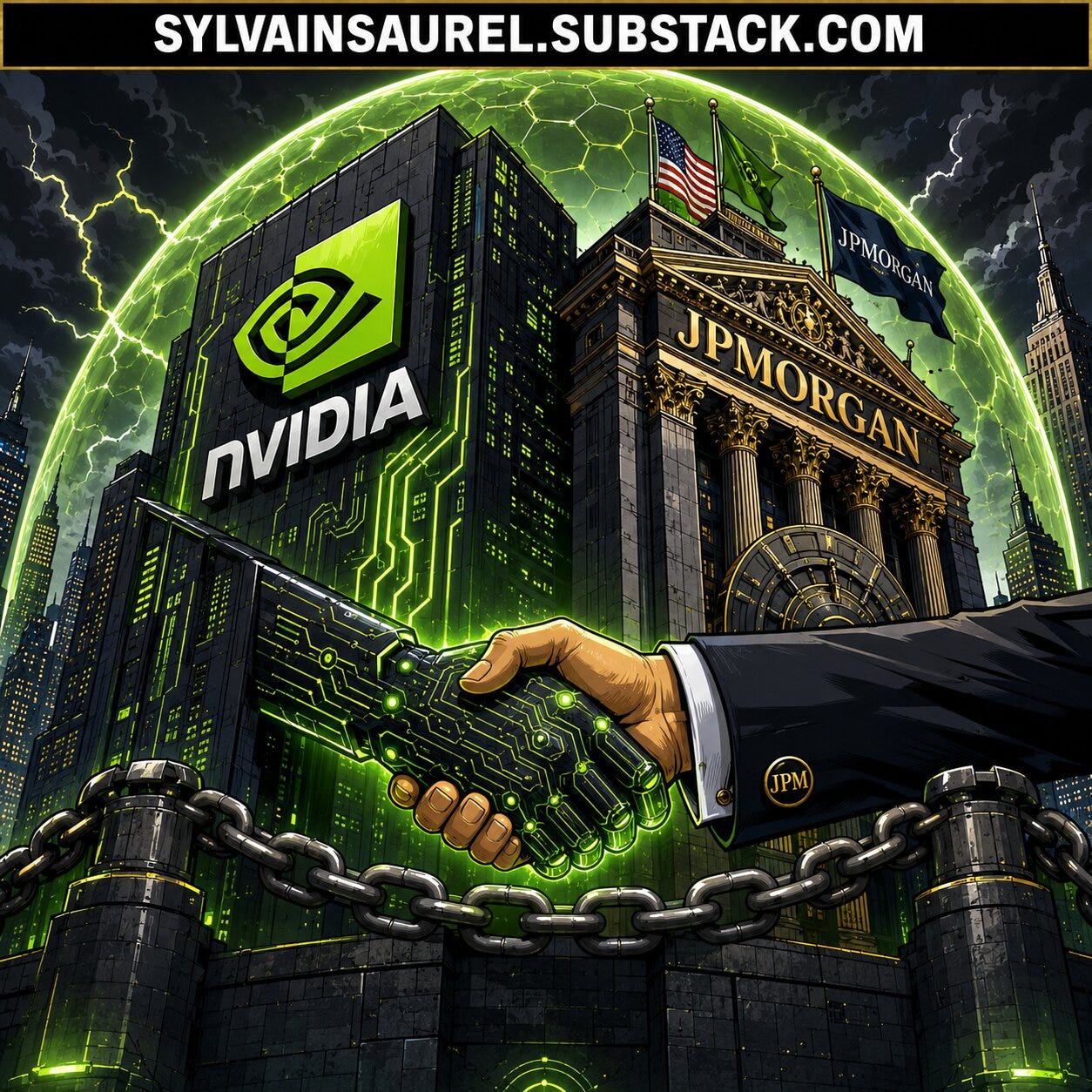
The technology sector is no longer merely a subset of the global economy; it is rapidly becoming the foundational infrastructure upon which the entire future of human enterprise is built. At the bleeding edge of this paradigm shift sits NVIDIA (NVDA), a company that has evolved from a niche graphics card manufacturer into the singular architect of the Artificial Intelligence revolution. Under the visionary leadership of Jensen Huang, NVIDIA has achieved a market dominance so absolute that its silicon is now treated as a quasi-sovereign asset.
However, technological supremacy is only one half of the equation for corporate immortality. The other half is financial invulnerability.
Recently, NVIDIA orchestrated a masterstroke by establishing a staggering $500 billion financing plan designed specifically for AI data center businesses. This monumental credit facility exists for one primary purpose: to provide the capital necessary for these data centers to purchase NVIDIA’s highly coveted GPUs. To fund this, NVIDIA has enlisted six leading U.S. financial institutions, with BlackRock—the world’s largest asset manager—anchoring the syndicate. This alone is a historic alignment of silicon and capital.
But it is not enough.
To transition from a dominant technology company to a permanently untouchable global institution, Jensen Huang must secure the final, missing piece of the puzzle. He needs to walk into the executive suites of 383 Madison Avenue and bring JPMorgan Chase & Co., led by Jamie Dimon, into the fold.
If NVIDIA successfully adds JPMorgan to a financing consortium that already includes BlackRock, the company will achieve something unprecedented in modern corporate history: Z-Level Security. By intertwining its financial architecture with the two most systemically critical pillars of the U.S. and global financial system, NVIDIA would effectively become immune to collapse. No matter what macroeconomic shocks occur, and no matter how many trillions of dollars in potentially bad financing are eventually tied to the AI infrastructure buildout, the Federal Reserve would be structurally forced to come to their rescue.
This article explores the deep mechanics of this strategy, the history of the “Too Big to Fail” doctrine, the financialization of compute, and why Jensen Huang’s next great conquest must be the world’s most strategically important bank.
The Silicon Standard: How NVIDIA GPUs Became the 21st Century's Most Powerful Financial Asset Class.

The global financial system has historically oriented itself around a handful of universally recognized asset classes. For centuries, physical commodities like gold, silver, and oil dictated the flow of capital. In the modern era, real estate, sovereign debt, and corporate equities formed the bedrock of institutional portfolios. But economic paradigms shift when technological revolutions demand it.
Part 1: The Silicon Paradigm Shift and the Cost of Intelligence
To understand the necessity of a $500 billion financing apparatus, one must first grasp the sheer scale and capital intensity of the AI revolution. We have exited the era of Moore’s Law—where CPUs doubled in transistor count every two years—and entered the era of Huang’s Law. In this new epoch, accelerated computing and generative AI require a fundamental rebuilding of the world’s data infrastructure.
The GPU as the New Global Currency
Historically, data centers were built using traditional Central Processing Units (CPUs) designed by companies like Intel and AMD. These chips were excellent for serial processing—handling tasks one after another in rapid succession. However, the architecture of Artificial Intelligence, specifically Large Language Models (LLMs) like those powering ChatGPT, Claude, and Gemini, requires parallel processing. This is where NVIDIA’s Graphics Processing Units (GPUs) reign supreme.
NVIDIA’s Hopper architecture (the H100) and the incoming Blackwell architecture are not merely computer parts; they are the engines of a new digital industrial revolution. They are the picks and axes of the AI gold rush, but with a critical caveat: they are astonishingly expensive. A single high-end AI GPU can cost upwards of $30,000 to $40,000, and a state-of-the-art AI data center requires tens of thousands—if not hundreds of thousands—of these chips operating in unison.
The Trillion-Dollar Infrastructure Pivot
Jensen Huang has repeatedly stated that there is currently a $1 trillion installed base of traditional data centers around the world that must be transitioned to accelerated computing over the next four to five years. This transition is not a luxury; it is an existential requirement for major technology companies, nation-states, and enterprise businesses.
However, building an AI data center is an exercise in extreme capital expenditure (CapEx). Beyond the cost of the GPUs themselves, data center operators must secure massive amounts of real estate, industrial-scale liquid cooling systems, and, most importantly, power. A single modern AI data center can consume as much electricity as a small city.
The hyperscalers—Microsoft, Google, Amazon, and Meta—have the balance sheets to fund this CapEx out of their own immense cash reserves. But the AI ecosystem is broader than just the hyperscalers. Specialized cloud providers (often referred to as “neo-clouds” or “GPU clouds”) like CoreWeave, Lambda Labs, and others are racing to build dedicated AI infrastructure. These companies do not have the trillion-dollar market caps of Big Tech. They need debt. They need leverage. They need financing.
This creates a massive capital vacuum. If NVIDIA wants to ensure that its chips continue to fly off the production lines without hitting a demand ceiling caused by a lack of customer capital, it must facilitate the financing.
Riot’s $9.1B Anthropic Deal: Bitcoin Miners Are Becoming AI Utilities.

How Bitcoin Mining’s Hidden Power Infrastructure Is Being Repriced for the AI Age—and Why Megawatts May Matter More Than Hashrate.
Part 2: The $500 Billion War Chest
This brings us to NVIDIA’s $500 billion financing plan. In the history of corporate finance, it is rare for a hardware manufacturer to involve itself so deeply in the capitalization of its downstream customers at this scale.
