
The Silicon Standard: How NVIDIA GPUs Became the 21st Century's Most Powerful Financial Asset Class.
From Sunk Cost to Sovereign Collateral: How a $500 Billion Wall Street Alliance is Bypassing Big Tech and Turning Compute into the Ultimate Global Currency.

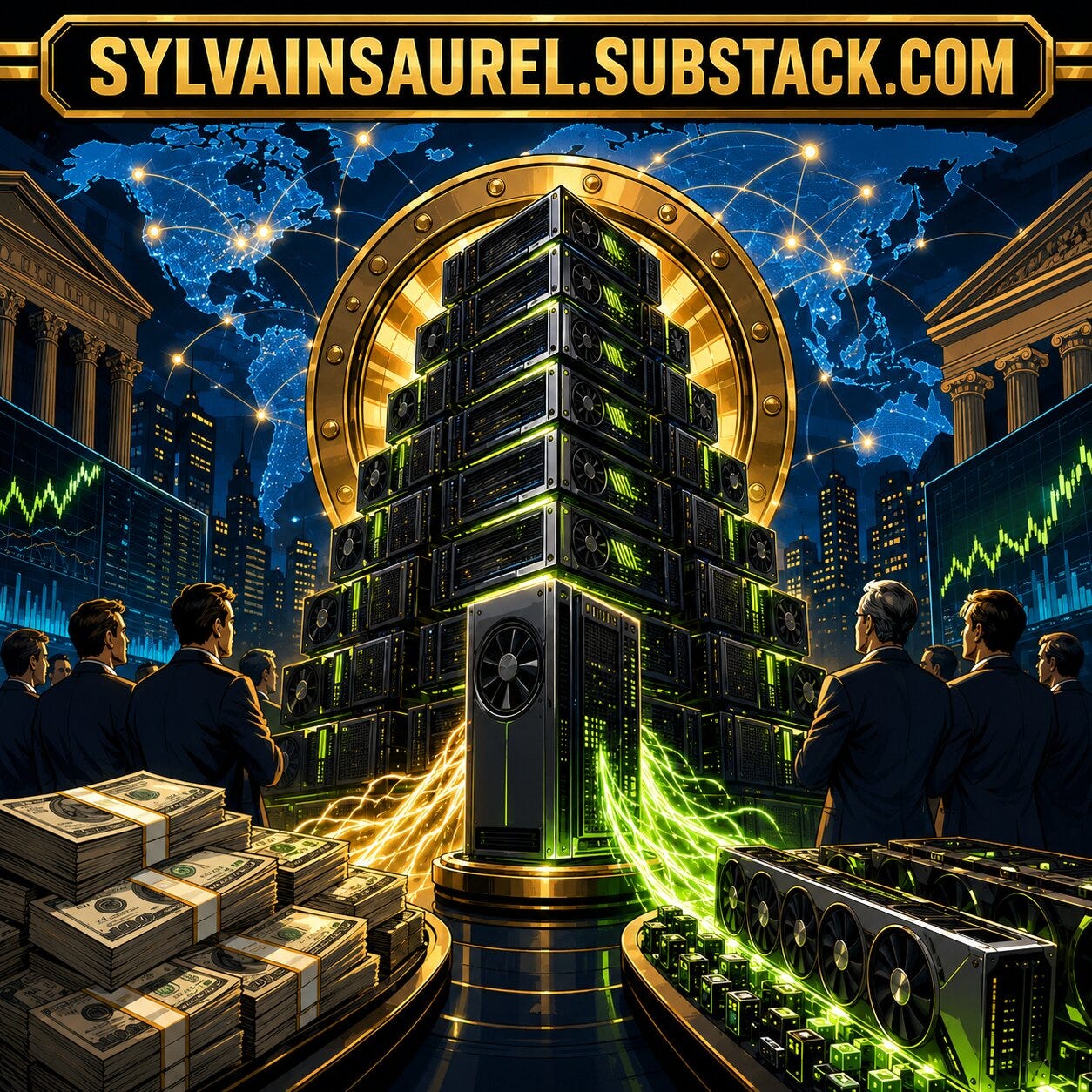
The global financial system has historically oriented itself around a handful of universally recognized asset classes. For centuries, physical commodities like gold, silver, and oil dictated the flow of capital. In the modern era, real estate, sovereign debt, and corporate equities formed the bedrock of institutional portfolios. But economic paradigms shift when technological revolutions demand it. Today, we are crossing the threshold into a fundamentally new era of capital formation.
NVIDIA GPUs are no longer just semiconductors; they have officially metamorphosed into a recognized, highly liquid, and universally valued financial asset class.
The watershed moment arrived with NVIDIA’s unprecedented announcement of strategic partnerships with the titans of global finance: Apollo, BlackRock, Blackstone, Brookfield, Goldman Sachs, and KKR. This consortium has been assembled to establish independent compute financing platforms designed to mobilize over $500 billion of third-party capital. Their singular mandate? To bankroll the aggressive, planetary-scale buildout of artificial intelligence infrastructure over the coming years.
To understand the magnitude of this shift, one must look beyond the silicon itself and examine the very mechanics of how human ambition is financed. By transforming the graphics processing unit (GPU) from a depreciating corporate expense into a bankable, asset-backed instrument, NVIDIA is rewriting the rules of corporate finance, directly challenging the monopoly of existing hyperscalers, and laying the financial groundwork for a future where compute is the ultimate currency.
NVIDIA, OpenAI, and the Quarter-Trillion Dollar Engine.

When the history of the 21st century is written, historians will look back at the present moment as the inflection point where the digital and physical worlds collided with unprecedented force. The proposition is staggering, almost defying modern economic comprehension:
Part I: The Genesis of Compute as Capital
To grasp why Wall Street’s most formidable institutions are committing half a trillion dollars to computer chips, we must first understand what makes an “asset class” viable in the eyes of institutional capital.
For an asset to be financeable on a massive, standardized scale, it must possess three core characteristics:
Intrinsic, Recognizable Value: It must generate economic utility.
Standardization: One unit of the asset must be functionally equivalent to another unit of the same class.
Liquidity and Transferability: In the event of a default, the asset must be easily seized, relocated, and resold or leased to a secondary market without a catastrophic loss of value.
Historically, commercial aircraft and maritime shipping vessels perfectly encapsulated these traits. A Boeing 777 or a Panamax cargo ship can be leased to an operator, and if that operator goes bankrupt, the financier simply repossesses the vessel and leases it to another airline or shipping company. The intrinsic value of the plane or ship is not tied to the specific company using it; it is tied to its global utility.
Before the AI revolution, enterprise hardware did not meet these criteria. Traditional servers were highly customized, rapidly depreciating, and tightly integrated into bespoke corporate networks. They were viewed as sunk costs—necessary operational expenditures, but practically worthless as collateral.
NVIDIA has utterly obliterated that reality. The modern AI GPU—specifically the upcoming NVIDIA Rubin architecture—is the modern equivalent of the commercial airliner. It is a highly standardized, universally demanded, incredibly powerful engine of economic production. Because every AI company, cloud provider, and enterprise globally relies on NVIDIA’s CUDA software ecosystem, an NVIDIA GPU holds its value across organizational boundaries.
When Apollo, BlackRock, and Goldman Sachs look at a data center filled with 100,000 NVIDIA GPUs, they no longer see a bespoke IT project. They see a fleet of universal, cash-flowing assets. They see the collateral required to underwrite the most ambitious infrastructure projects in human history.
The $400 Billion Masterstroke: Elon Musk, NVIDIA, and the 10-Gigawatt AI Revolution.

The tech and financial worlds are experiencing a tectonic shift, and its epicenter is a single, staggering declaration from the most ambitious engineer of our time.
