
The Day Google AI Died: From Algorithmic Pioneer to Compute Landlord.
Infinite compute, zero agility: How a devastating brain drain forced Google to abandon the race for AGI and sell the shovels instead.

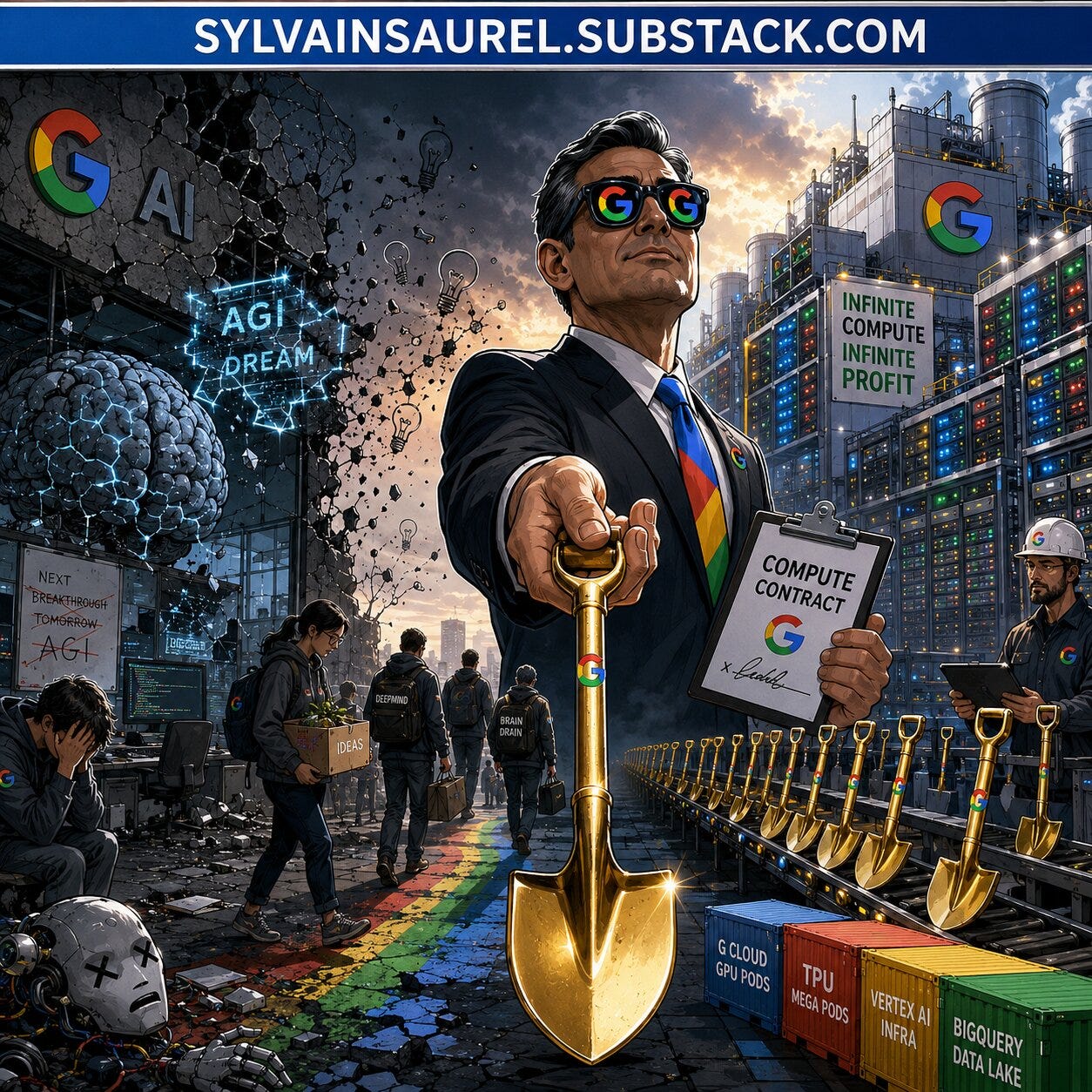
The unthinkable has happened, not with an explosion, but with a series of quiet, devastating departures that culminated in a singular, inescapable truth: Google AI died today.
For nearly two decades, Google was synonymous with the future of artificial intelligence. It was the undisputed vanguard, the academic titan, the corporate powerhouse that housed the brightest minds on the planet. Yet, today marks the definitive end of an era, a paradigm shift so profound that the tremors will be felt across Silicon Valley, Wall Street, and every academic institution studying machine learning. This is not merely a corporate restructuring; it is one of the most significant and spectacular failures of innovation management in modern corporate history.
The definitive blow came today with a series of announcements that hollowed out the core of what made Google the epicenter of the AI universe. Jeff Dean, the legendary founder of Google Brain, one of the primary architects of Google’s AI efforts, and a central pillar of the company’s engineering culture for 27 years, announced his departure. Alongside him, Demis Hassabis, the visionary AI giant, Nobel Prize winner, and founder of DeepMind, officially stepped away from Google’s day-to-day AI operations, relegated to the largely ceremonial role of Chief Scientist.
These massive shifts at the top are not isolated incidents. They follow a brutal, months-long exodus of top-tier talent. Elite researchers—the vanguard of the generative AI revolution—including John Jumper and Noam Shazeer, have already packed their bags, defecting to fiercely competitive frontier labs like Anthropic and OpenAI.
Essentially, Google’s AI team has been entirely hollowed out. The vibrant, pioneering culture that once made Google AI the undisputed global leader has vanished, replaced by bureaucracy, panic, and a frantic defensive posture. The brain drain is complete, and the autopsy reveals a startling paradox: Google had more money, infinitely more proprietary data, and vastly more computing power available to its researchers than any other AI lab in existence, yet it completely failed to deliver when the moment of truth arrived.
To understand the magnitude of this collapse, we must dissect the individuals involved, the culture that was lost, the devastating “innovator’s dilemma” that paralyzed the company, and the profound pivot Google is now forced to make to survive in an AI-dominated world.
The Return of Zero-Confirmation Bitcoin: Instant Payments Without Lightning—or PayPal in Disguise?

A new co-signed protocol promises instant on-chain commerce with a unilateral escape hatch. It may revive Bitcoin’s oldest dream—or prove that speed always smuggles trust back in.
Chapter I: The Departure of the Architect — Jeff Dean’s 27-Year Legacy
To say that Jeff Dean was an employee at Google is like saying undeniably that Isaac Newton dabbled in mathematics. For 27 years, Jeff Dean was the architectural soul of Google’s most transformative technologies. His departure is not just the loss of an executive; it is the severing of a foundational artery.
Dean joined Google in 1999, when the company was little more than a scrappy search engine operating out of cramped offices. He was instrumental in designing the distributed computing infrastructure that allowed Google to scale at a pace never before seen in human history. Systems like MapReduce, Bigtable, and Spanner—the very nervous system of the modern internet—were birthed from his intellect. These systems didn’t just power Google Search; they laid the groundwork for the entire cloud computing industry.
When Dean pivoted his focus to artificial intelligence, co-founding Google Brain alongside Andrew Ng, he brought that same systems-level genius to machine learning. Google Brain was not just a research lab; it was a factory of miracles. Under Dean’s stewardship, the team developed TensorFlow, the open-source machine learning framework that democratized AI development and became the industry standard for a crucial half-decade. Dean fostered a culture of immense ambition, pushing the boundaries of deep learning, neural networks, and massive-scale compute architectures.
His vision for AI was vast and inclusive, focusing on models that could generalize across thousands of tasks—what he later dubbed the “Pathways” architecture. But as the years progressed, the agile, hacker-like environment of early Google Brain became bogged down by the sheer mass of the corporate entity it served. Dean, an engineer at heart who thrived on solving impossible technical problems, found himself increasingly entangled in executive administration, product roadmaps, and the defensive posturing required to protect Google’s search monopoly.
Leaving after 27 years signals a profound disillusionment. When the architect abandons the skyscraper he designed, it sends a clear message about the structural integrity of the building. Dean’s departure removes the institutional memory and the technical credibility that kept many researchers anchored to Google during turbulent times. Without him, the Google Brain legacy is officially a closed chapter in the history books of computer science.
The Wall Street Algorithm: How Citadel Engineered the Great AI Reset of 2026.

Crash it. Buy it. Call it a reset.
Chapter II: A Nobel Laureate Sidelined — The Demis Hassabis Paradox
If Jeff Dean was the master builder of Google’s infrastructure, Demis Hassabis was its philosophical visionary. The founder of DeepMind, Hassabis approached artificial intelligence not just as an engineering challenge, but as the ultimate scientific frontier. A former child chess prodigy and a cognitive neuroscientist, Hassabis built DeepMind with a singular, unapologetic goal: to solve intelligence, and then use that to solve everything else.
Google acquired DeepMind in 2014 in what was then a landmark deal, giving Hassabis the financial runway to pursue Artificial General Intelligence (AGI). For years, the marriage was incredibly fruitful. DeepMind operated with a fierce independence in London, physically and culturally insulated from the bureaucratic sprawl of Mountain View.
Under Hassabis, DeepMind delivered some of the most awe-inspiring breakthroughs of the 21st century. AlphaGo’s stunning victory over Lee Sedol in 2016 proved that machines could master games of intuition and creativity, fundamentally altering the global perception of AI’s potential. But it was AlphaFold that truly cemented Hassabis’s legacy, successfully predicting the 3D structures of almost all known proteins—a breakthrough so monumental in biology and medicine that it rightly earned him a Nobel Prize.
However, the generative AI boom ignited by OpenAI fundamentally changed Google’s tolerance for DeepMind’s independent, long-term research horizon. As panic set in following the launch of ChatGPT, Google’s leadership made the desperate decision to merge Google Brain and DeepMind into a single entity: Google DeepMind. The forced marriage was fraught from the start. Merging two drastically different cultures—one focused on product-driven machine learning, the other on pure scientific discovery—resulted in a clash of egos, priorities, and methodologies.
Hassabis stepping away from the day-to-day operations to assume the role of “Chief Scientist” is a classic corporate maneuver. In Silicon Valley parlance, moving a dynamic, operational leader to a Chief Scientist role is often a golden parachute—a way to sideline a brilliant mind without the public relations disaster of firing them. It allows the corporate machinery to take over product development while keeping the visionary’s name on the masthead for prestige.
But the reality is stark: Hassabis is no longer steering the ship. The visionary who believed AI could cure diseases and unlock the mysteries of the universe has been neutralized by a corporate imperative to build chatbots that can sell advertisements. It is a tragic misallocation of human genius, and his step back signals the death of DeepMind’s original, pure pursuit of AGI under the Google banner.
5.24%: The Number Terrifying the U.S. Treasury.

The foreign exchange market is often the theater of silent clashes. Still, occasionally, the tectonic plates of global finance begin to tremble with such violence that the shockwave propagates across all asset classes. What we have just witnessed with the spectacular rebound of the Japanese yen is not a simple technical correction or a fleeting tremor.
Chapter III: The Great Exodus — Jumper, Shazeer, and the Brain Drain
While the departures of Dean and Hassabis are the headline-grabbers, the true fatal blow to Google’s AI ambitions happened in the trenches. Over the past several months, a steady trickle of the world’s most elite AI researchers became a torrential flood. The defections of figures like John Jumper and Noam Shazeer to rivals like Anthropic and OpenAI illustrate the absolute collapse of Google’s retention power.
John Jumper was the crucial co-creator of AlphaFold. His work alongside Hassabis revolutionized computational biology. Jumper represents the rare breed of researcher who bridges the gap between deep learning and the hard sciences. His departure to a rival lab signifies a massive transfer of interdisciplinary knowledge. He didn’t just take his coding skills; he took his intimate understanding of how to apply massive neural networks to complex scientific phenomena.
Noam Shazeer’s departure is arguably even more poetically devastating. Shazeer was one of the brilliant minds at Google who co-authored the legendary 2017 paper, “Attention is All You Need.” That paper introduced the Transformer architecture—the absolute bedrock of every large language model in existence today, from GPT-4 to Claude to Google’s own Gemini. Shazeer is quite literally one of the fathers of the current AI revolution.
After leaving Google to found his own startup, Character.AI, he was recently re-absorbed into the Google machine in a desperate acqui-hire attempt, only to ultimately depart again for greener, more agile pastures. The fact that Google invented the Transformer, yet could not retain the very individuals who conceptualized it, is the most glaring indictment of its corporate environment.
These researchers didn’t leave because they were offered slightly higher salaries. In the world of frontier AI, money is virtually infinite everywhere. They left because of velocity. They left because frontier labs like OpenAI and Anthropic are designed to ship, to iterate, and to push the boundaries without requiring six layers of legal and PR approvals for every model weight update. When researchers of this caliber leave, they take the momentum with them. They are the gravity wells that attract junior talent, and their absence leaves a vacuum that no amount of stock options can fill.
Sold Out Until 2028: Inside the Cutthroat Race for the World's Remaining AI Compute.

As the sweltering summer of 2026 blanketed global financial capitals, Wall Street was holding its collective breath. For months, a prevailing, anxious narrative had begun to take root among institutional investors, macroeconomic analysts, and tech pundits alike. The theory was simple, historically grounded, and ultimately, entirely wrong:
