
The Wall Street Algorithm: How Citadel Engineered the Great AI Reset of 2026.
How Wall Street's apex predator weaponized a $45 billion margin call to buy the future of AI for pennies on the dollar.

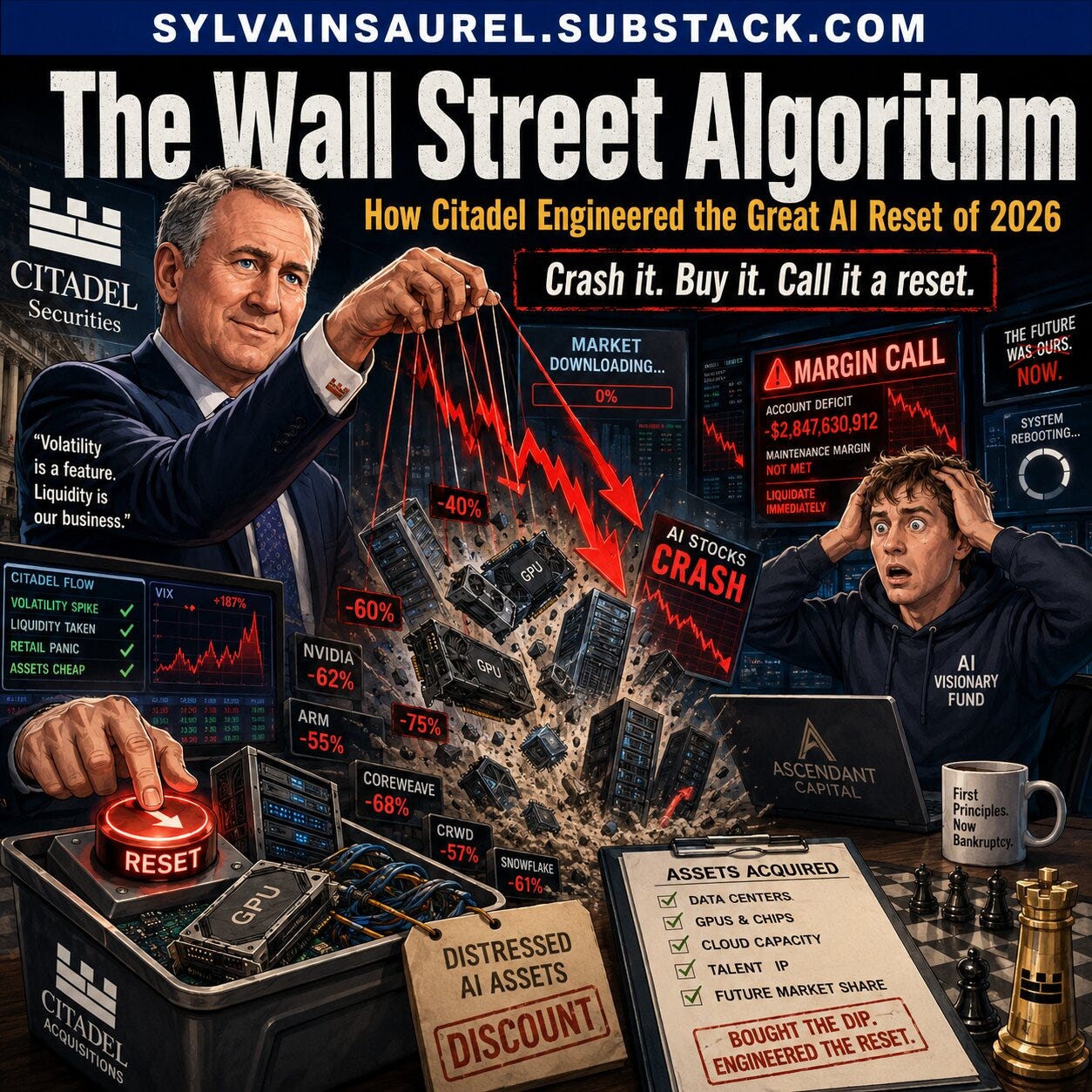
Crash it. Buy it. Call it a reset.
It is the oldest, most ruthlessly effective playbook in the history of high finance. From J.P. Morgan locking the doors of his library during the Panic of 1907 to the distressed asset bonanzas of the 2008 Great Financial Crisis, the apex predators of Wall Street have always understood one fundamental truth: the greatest wealth is generated not by predicting the future, but by providing liquidity to desperate visionaries when the present collapses.
Today, that playbook has been executed with surgical precision in the AI sector. The target? Leopold Aschenbrenner’s monolithic $45 billion hedge fund, Situational Awareness. The architect of the rescue? Ken Griffin’s Citadel.
At first glance, the events of July 2026 look like a standard market correction—a much-needed cooling-off period for an overheated artificial intelligence sector. But a closer examination of Citadel’s recent market commentary, cross-referenced with the catastrophic margin calls that gutted Aschenbrenner’s fund, reveals a deeply interconnected narrative.
It is a story of astronomical leverage, crowded trades, strategic market posturing, and the brutal reality that being intellectually right is entirely different from being financially solvent.
Here is the untold story of how one of the most brilliant minds in AI research built a financial powder keg, how the market establishment lit the match, and how the resulting explosion allowed Citadel to acquire the future of AI infrastructure at a steep discount.
5.24%: The Number Terrifying the U.S. Treasury.

The foreign exchange market is often the theater of silent clashes. Still, occasionally, the tectonic plates of global finance begin to tremble with such violence that the shockwave propagates across all asset classes. What we have just witnessed with the spectacular rebound of the Japanese yen is not a simple technical correction or a fleeting tremor.
Part I: The Prophet of AGI Moves to Wall Street
To understand the magnitude of what just occurred, one must first understand Leopold Aschenbrenner.
Aschenbrenner was not your traditional Wall Street quant, nor was he a veteran portfolio manager molded by the rigid risk-management cultures of multi-strategy firms. He was a former OpenAI researcher, a prodigious talent who spent years deep inside the trenches of foundational model development. While the rest of the world was arguing over the capabilities of language models, Aschenbrenner was focused on the endgame: Artificial General Intelligence (AGI).
In 2024, Aschenbrenner published a seminal series of essays titled Situational Awareness. The core thesis was audacious yet methodically argued: the path to AGI was not decades away, but imminent, constrained only by the physical realities of compute power, energy generation, and data center infrastructure. He argued that the world was about to see capital expenditure on a scale unprecedented in human history, transitioning from billions to trillions of dollars to build the physical backbone of machine intelligence.
Wall Street read the essays. The sovereign wealth funds read them. Silicon Valley royalty read them. But Aschenbrenner realized something crucial: writing about the future pays in prestige; investing in the physical infrastructure of the future pays in generational wealth.
By late 2024, Aschenbrenner parlayed his insider credibility and visionary foresight into raising capital. The result was a hedge fund aptly named after his manifesto: Situational Awareness. Institutional investors, desperate for an edge in a market completely dominated by the AI narrative, threw money at him. The fund swelled to an astonishing $45 billion in assets under management (AUM) by the beginning of 2026.
For the first six months of 2026, Aschenbrenner was untouchable. He didn’t just beat the market; he humiliated it. His fund posted a staggering 439% return through the first half of the year. He achieved this not by trading complex derivatives or engaging in high-frequency arbitrage, but through hyper-concentrated, conviction-driven bets on the picks and shovels of the AI gold rush.
He loaded the boat on companies like CoreWeave (the elite GPU cloud provider that became the darling of AI startups) and Nebius (the burgeoning AI infrastructure and compute platform). If a company was laying fiber optics for data centers, building advanced cooling systems for server racks, or monopolizing GPU compute allocation, Situational Awareness owned it.
But conviction is a dangerous drug when mixed with borrowed money.
Meet the “Nostradamus of AI”: The 24-Year-Old Mastermind Behind a $20 Billion Empire.

With $20 billion under management and a cult following on Wall Street, Leopold Aschenbrenner is reshaping global finance. Is he a generational genius, or the face of AI’s biggest bubble?
Part II: The Architecture of Fragility
The 439% return that made Aschenbrenner a Wall Street legend by June 2026 was not purely the result of asset appreciation. It was the result of massive, unyielding leverage.
Traditional hedge funds might run leverage ratios of 1.5x or 2x on their equity books. Aschenbrenner, operating with the absolute certainty of a technologist who believed he had solved the timeline to AGI, employed leverage of four to five times his equity base.
To understand the mathematical fragility of this structure, we must look at the mechanics of margin. When a fund operates at 5x leverage, it means for every $1 of actual investor capital, the fund borrows $4 from its prime brokers.
The underlying math dictates the survival of the fund. Let V represent the total portfolio value, E represent the equity, and D represent the debt. The leverage ratio L is expressed as:
At 5x leverage, a 20% decline in the value of the underlying assets (V) completely wipes out the equity (E). Long before the assets drop 20%, however, the prime brokers—the massive investment banks lending the money—will issue a margin call to protect their downside.
During the historic run-up in the first half of 2026, the prime brokerage desks at Bank of America, Goldman Sachs, and JPMorgan Chase were more than happy to extend this credit. The collateral consisted of the most liquid, highly sought-after AI and semiconductor stocks in the world. The value of the collateral was rising every single day. Risk models flashed green.
However, Situational Awareness had created two distinct systemic vulnerabilities:
Concentration Risk: The fund was not diversified. It was an all-in bet on AI infrastructure. If the sector experienced a sudden repricing, the fund had no uncorrelated assets (like bonds, commodities, or defensive equities) to cushion the blow.
The Crowded Trade: Aschenbrenner was a thought leader. Because his essays were public and his fund’s holdings were widely tracked, half the market piled into the same trades. Retail investors, momentum-chasing algorithmic funds, and leveraged ETFs all latched onto CoreWeave, Nebius, and the broader semiconductor index.
Aschenbrenner was sitting on top of a $45 billion powder keg. The fuse was exposed, waiting for a spark. And on Wall Street, if a powder keg is left unguarded, someone will eventually light it.
The Asymmetric Infrastructure Trade: Why Oracle is the Ultimate Proxy for OpenAI's Success.

In the rapidly evolving landscape of artificial intelligence, market participants are perpetually hunting for the most efficient vectors of capital allocation. While the retail focus remains fixated on the consumer-facing applications of generative AI and the underlying designers of graphics processing units (GPUs), a profound mispricing has emerged in the infrastructure layer.
Part III: The Catalyst and The Citadel Whisper
Markets are ultimately narrative engines. The physical reality of a company’s cash flow takes a backseat to the collective psychological belief about its future.
By late June 2026, the AI narrative was priced for absolute perfection. Earnings multiples for infrastructure companies had stretched into the stratosphere. The market required a flawless macroeconomic backdrop to sustain these valuations—specifically, low interest rates, which make the future cash flows of high-growth tech companies more attractive in present-day terms.
Enter Citadel.
