
The Unbreakable Engine: Why Markets Rise from the Ashes.
7 timeless principles to silence the panic, master the laws of human progress, and turn the next crash into your greatest opportunity.

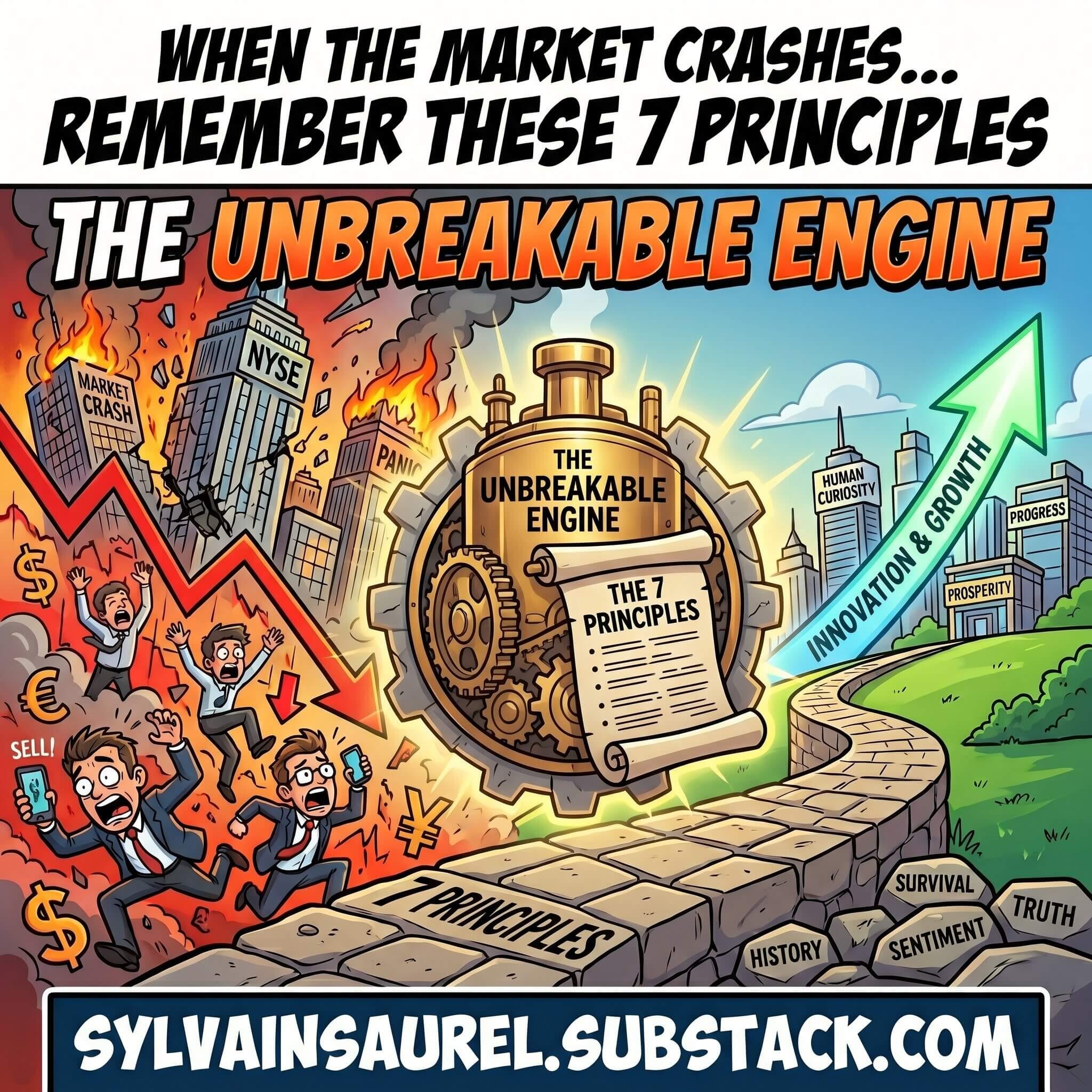
The screens turn red. News anchors adopt somber tones, speaking in hushed voices about “capitulation,” “recession,” and “freefall.” Your portfolio, which represented years of hard work and disciplined saving, shrinks by double-digit percentages in a matter of days or weeks. The visceral reaction is biological; it is a fight-or-flight response triggered by a threat to your security.
In these moments of chaotic descent, the natural human instinct is to flee—to sell, to cash out, to stop the bleeding. It feels like the prudent thing to do. It feels like safety.
But history, philosophy, and the laws of human nature tell us that this instinct is wrong.
To navigate the storms of volatility, one must look beyond the ticker tape and understand the fundamental machinery of human civilization. When the market crashes, it is not the end of the world; it is usually a transfer of wealth from the impatient to the patient, from the fearful to the faithful.
Here are the 7 fundamental principles you must remind yourself of every time the market crashes. These are not just investment tips; they are the laws of economic physics.
Principle 1: The Lindy Effect of Civilization
“We have survived countless wars, pandemics, and natural catastrophes, and yet markets are still functioning well.”
If you were to zoom out on a chart of the global economy over the last 200 years, the Great Depression, two World Wars, the Cold War, the dot-com bubble, the 2008 financial crisis, and the COVID-19 pandemic would appear as mere blips on an upward trajectory.
This is the first principle of market resilience. The market is not a fragile vase that shatters when dropped; it is an antifragile ecosystem that often grows stronger under stress.
Consider the gravity of the 20th century. Humanity tore itself apart in two global conflicts. We developed nuclear weapons capable of erasing civilization. We faced influenza strains that wiped out millions. And yet, through the rubble of Berlin, the jungles of Vietnam, and the panic of Wall Street, the engine of commerce kept turning.
Why? Because the market is simply the aggregate of human survival. As long as humans need to eat, clothe themselves, and build shelter, the market will exist. A crash is a temporary dislocation, a pause in the music, but the orchestra has never stopped playing for good. To bet against the market over the long term is to bet against the survival of the human species. History suggests that it is a losing bet.
The Four Ideologies of Bitcoin: Navigating the Friction Between Thermodynamics, Wall Street, and the Code.

Sovereignty, Capital, and Code: Deconstructing Michael J. Saylor’s Matrix for the Future of Money.
Principle 2: The Illusion of the “Broken” Market
“Markets never crash; what crashes is the sentiment of market participants. They act emotionally, and later they realize their mistake, and the market goes up again.”
