
The Ultimate Alpha: Why Wall Street Cannot Afford to Ignore Donald Trump's $1.2 Million Presidential Paywall.
Front-Running Reality: How Five Minutes of Early Access to the Commander-in-Chief Creates the Greatest Asymmetric Trade in Modern Finance.

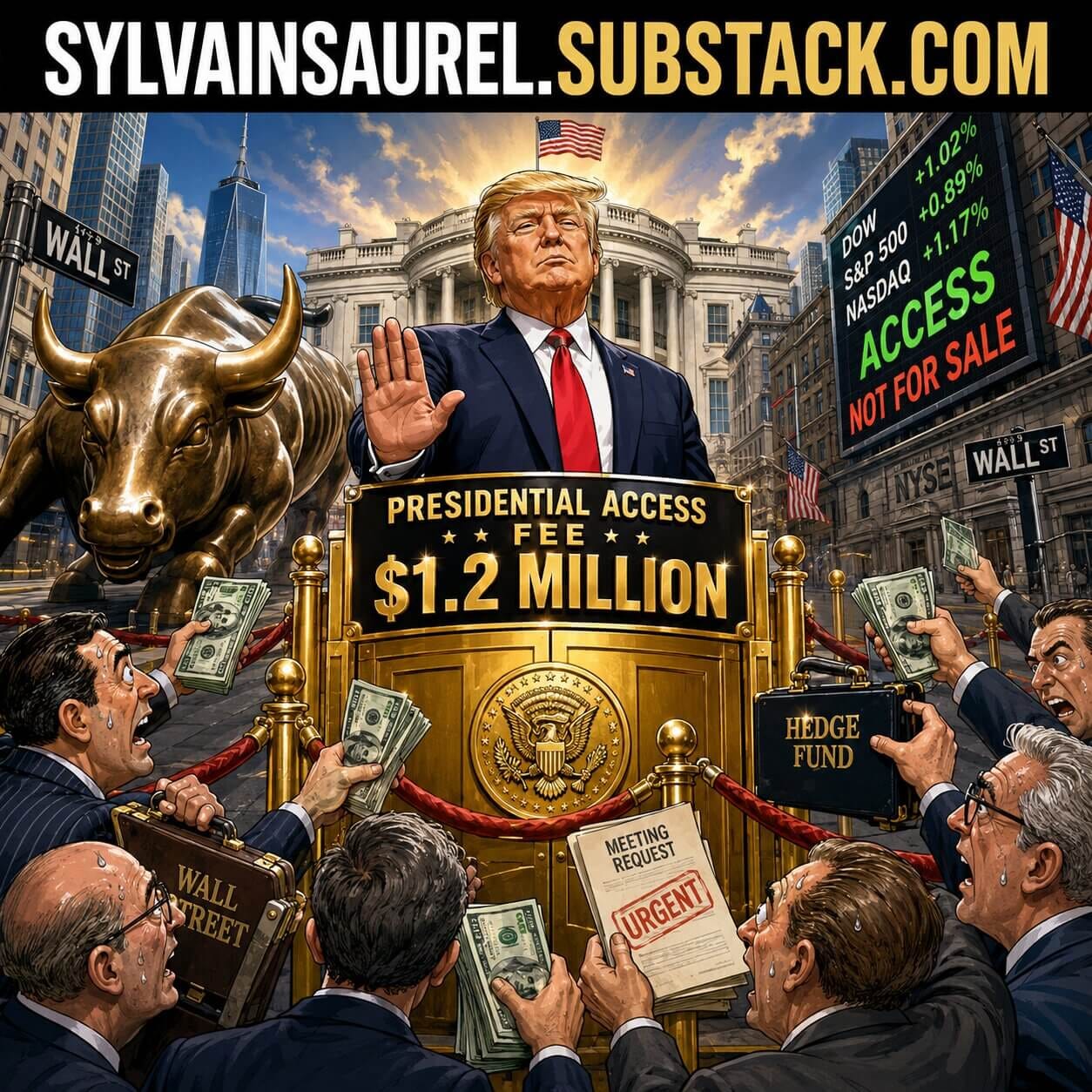
In the high-stakes, hyper-competitive ecosystem of institutional finance, the search for “alpha”—the elusive ability to generate returns above the market benchmark—is relentless. Hedge fund managers, private equity barons, and family offices spend tens of millions of dollars annually on alternative data sets, satellite imagery of retail parking lots, algorithmic trading infrastructure, and quantitative analysts holding doctorates in astrophysics. They do all of this for the slimmest of margins: a fraction of a percentage point that separates a lucrative year from a disastrous one.
Yet, imagine a scenario where the ultimate market signal is available for a flat subscription fee.
Assume you manage a portfolio of over $100 million. Trump Media announces a groundbreaking, highly controversial, yet brutally effective tiered system: subscribers who pay $100,000 per month will receive “early access” to Donald Trump’s social media posts before they are released to the general public.
At first glance, an annual subscription cost of $1.2 million sounds exorbitant. It sounds like an outrageous monetization of the digital public square. But when subjected to the cold, rational, and ruthless mathematics of modern financial markets, the conclusion is inescapable: That cost is not just minimal; paying it is an absolute fiduciary duty.
The easiest, most historically proven way to make money in the stock market is not through perfectly optimized discounted cash flow models, nor through deciphering the arcane patterns of technical analysis. The easiest way to make money is to acquire material, non-public information about a specific asset, sector, or macroeconomic condition before anyone else does.
And who has access to more market-moving, macroeconomic, and geopolitical information than the sitting President of the United States? Absolutely no one.
This article provides a comprehensive, multi-disciplinary deep dive into the mechanics of this theoretical subscription, the history of political intelligence in financial markets, the staggering wealth of U.S. lawmakers as a proof of concept, and the fundamental market theory that explains why $1.2 million for the President’s feed is the greatest asymmetric trade of the century.
Deconstructing the Memory Stock Sell-Off—And the Generational Disconnect Between Narrative and Reality.

The financial markets are, at their core, a pendulum that swings violently between irrational exuberance and unfounded terror. Right now, in the semiconductor and memory sectors, we are witnessing the latter. Billions of dollars in market capitalization are being wiped out, retail investors are panic-selling, and institutional algorithms are triggering stop-losses based on a narrative that belongs in a science fiction novel, not a serious investment thesis.
Part I: The Mathematics of Information Asymmetry
To understand why a $100,000 monthly fee is a bargain, we must first break down the fundamental economics of managing a $100 million portfolio.
The Cost-to-AUM Ratio
In institutional asset management, expenses are measured in basis points (bps), where one basis point equals one-hundredth of a percent (0.01%).
A portfolio manager handling $100 million typically charges a standard management fee of 1% to 2% annually.
A $1.2 million annual subscription represents exactly 1.2% of a $100 million portfolio (120 basis points).
While 120 basis points is a significant expense line item, it must be evaluated against the potential gross return it generates. In the world of high finance, costs are entirely relative to the yield they produce. If you spend $1.2 million to make $1.5 million, you have made a poor investment due to risk-adjusted returns. But if you spend $1.2 million to systematically generate multi-millions in pure, relatively risk-free profit, the expense becomes negligible.
The Volume and Velocity of Presidential Signals
How does the subscription pay for itself? We must look at the historical behavior of the asset in question: the digital communications of Donald Trump.
During his first term in office, Donald Trump revolutionized the way the presidency interacted with the financial markets. Traditional presidents used the Treasury Department, the Federal Reserve, or carefully scheduled, highly vetted press conferences to signal economic shifts. Trump used social media. His posts were raw, immediate, and heavily focused on the stock market, international trade, and specific American corporations.
If we extrapolate this behavior into a theoretical framework where he posts about the market just once or twice a week, a premium subscriber is looking at 50 to 70 market-related posts per year.
Not every post will be a tradable event. Some will be political rhetoric, and some will be general economic cheerleading. However, among those 50 to 70 posts, a portfolio manager will undoubtedly receive a couple of high-conviction signals from the Commander-in-Chief.
The Anatomy of the Perfect Trade
Let us mathematically model a single high-conviction trade generated by this early-access feed.
Imagine the President posts the following to his premium tier subscribers, five minutes before it goes to the public feed:
“China has broken their promise on agricultural purchases. Unacceptable! Effective Monday, I am placing a 50% tariff on all imported Chinese electric vehicles and solar panels. We will protect American manufacturing!”
As a subscriber, you receive this signal at 10:00 AM. The public will see it at 10:05 AM. In the world of institutional trading, five minutes is not an eternity—it is an entire geologic epoch.
The Allocation: You manage $100 million. Recognizing the certainty of the market reaction, you allocate just 10% of your portfolio ($10 million) to a highly liquid, targeted strategy.
The Execution: Your algorithms instantly short major Chinese EV manufacturers and heavily buy call options on American legacy automakers and domestic solar manufacturers.
The Yield: Because you entered the market before the news hit the public domain, your entry price is untouched by the impending volatility. At 10:05 AM, the post goes public. Retail investors, high-frequency trading algorithms scraping public feeds, and competing funds scramble to react. The target stocks gap up or down violently.
The Return: Such a geopolitical shock will easily generate a 30% to 40% swing in the underlying targeted assets—especially if utilizing options contracts with embedded leverage.
The Profit: A 30% to 40% return on your $10 million allocation generates $3 million to $5 million in pure profit.
In a single morning, with a single post, you have generated enough profit to pay the $1.2 million annual subscription fee three times over. The remaining 49 to 69 market-related posts for the rest of the year represent pure, unadulterated alpha. The $1.2 million cost is not just minimal; it is the most efficient deployment of capital in the fund’s history.
The Sovereign of the Stack: How Elon Musk Conceded the AI Battle to Win the Compute War.

“Anthropic has done it. There is no model on Earth as strong as Mythos or Fable right now. They are the clear leaders in artificial intelligence, and from what I am seeing, Mythos 2 is already close.”
Part II: The Presidential Megaphone and Historical Precedent
To skeptical observers, the idea of generating 30% to 40% returns “with ease” based on a social media post might sound hyperbolic. However, recent market history proves that the Presidential megaphone is the single most powerful volatility-inducing instrument on the planet.
The Power to Move Trillions
The President of the United States commands an intelligence and economic apparatus that dwarfs the research departments of every major Wall Street bank combined. The White House has advance notice on non-farm payroll reports, Consumer Price Index (CPI) data, Gross Domestic Product (GDP) revisions, pending Department of Justice antitrust investigations, FDA drug approvals, and intricate details of foreign trade negotiations.
When a sitting President speaks about a company, the market listens because the President has the power of the administrative state behind him. He can direct federal procurement contracts, initiate regulatory scrutiny, or impose tariffs with the stroke of a pen.
Let us examine historical case studies that validate the immense value of early access to such statements:
The Defense Sector Jolts: Consider the historical instances where sudden social media posts targeted defense contractors. A post criticizing the cost overruns of a specific fighter jet program immediately sent the stock of the manufacturing company plummeting by billions of dollars in market capitalization within seconds. A trader with early access could have easily shorted the stock or bought put options, capturing massive downside profit before the rest of the market even refreshed their screens.
The Pharmaceutical Sector: Posts targeting prescription drug prices or specifically naming pharmaceutical companies for “getting away with murder” have historically triggered sector-wide selloffs. Early knowledge of such statements allows a fund to pivot out of long healthcare positions and transition into a short stance before the retail market reacts.
The Trade War Volatility: During the height of the U.S.-China trade negotiations, the global macroeconomic environment was dictated entirely by sudden posts regarding tariffs. A post stating that talks were going well would send the S&P 500 futures skyrocketing; a post stating that tariffs were being increased would send them plunging.
The easiest way to make money in the market is to acquire material non-public information about a specific asset or market. And who has more insider information than the sitting President of the United States? No one.
This assertion I made in the introduction is not just rhetorically strong; it is an undeniable empirical fact. The President does not just report on the market; the President creates the market reality. An early access feed allows a subscriber to front-run reality itself.
The Ultimate Binary: Why SpaceX is Worth Either a Quadrillion Dollars or Absolutely Nothing.

If you look at the modern financial landscape, you will find a myriad of companies that fit neatly into traditional models of valuation. You can calculate their Discounted Cash Flow (DCF), analyze their Price-to-Earnings (P/E) ratios, project their steady-state growth, and arrive at a reasonable estimate of their intrinsic value. These are continuous stories. They grow by 5% here, capture 2% of market share there, and occasionally suffer a cyclical downturn.
Part III: Material Non-Public Information (MNPI) and the Washington Machine
To fully appreciate the value of the $100,000-per-month subscription, we must address the elephant in the room: the concept of Material Non-Public Information (MNPI) and the legality of trading on it.
The Holy Grail of Investing
In standard financial regulatory frameworks, trading on MNPI is the textbook definition of insider trading, a felony that has sent high-profile billionaires and hedge fund managers to federal prison. The Securities and Exchange Commission (SEC) mandates that if you possess material information that has not been disseminated to the general public, you cannot legally trade securities based on that information.
However, Washington, D.C. operates under a vastly different, notoriously porous set of rules. The intersection of political intelligence and financial markets is a multi-billion-dollar grey area.
