
The Exponential Reckoning: How Anthropic Defied the Doomers, Captured $50 Billion, and Set Its Sights on Rewriting Human Biology.
From a $100M baseline to a $50B juggernaut in under 30 months: Inside the unprecedented 80% margins and the strategic compute alliance driving the greatest wealth creation engine in modern history.

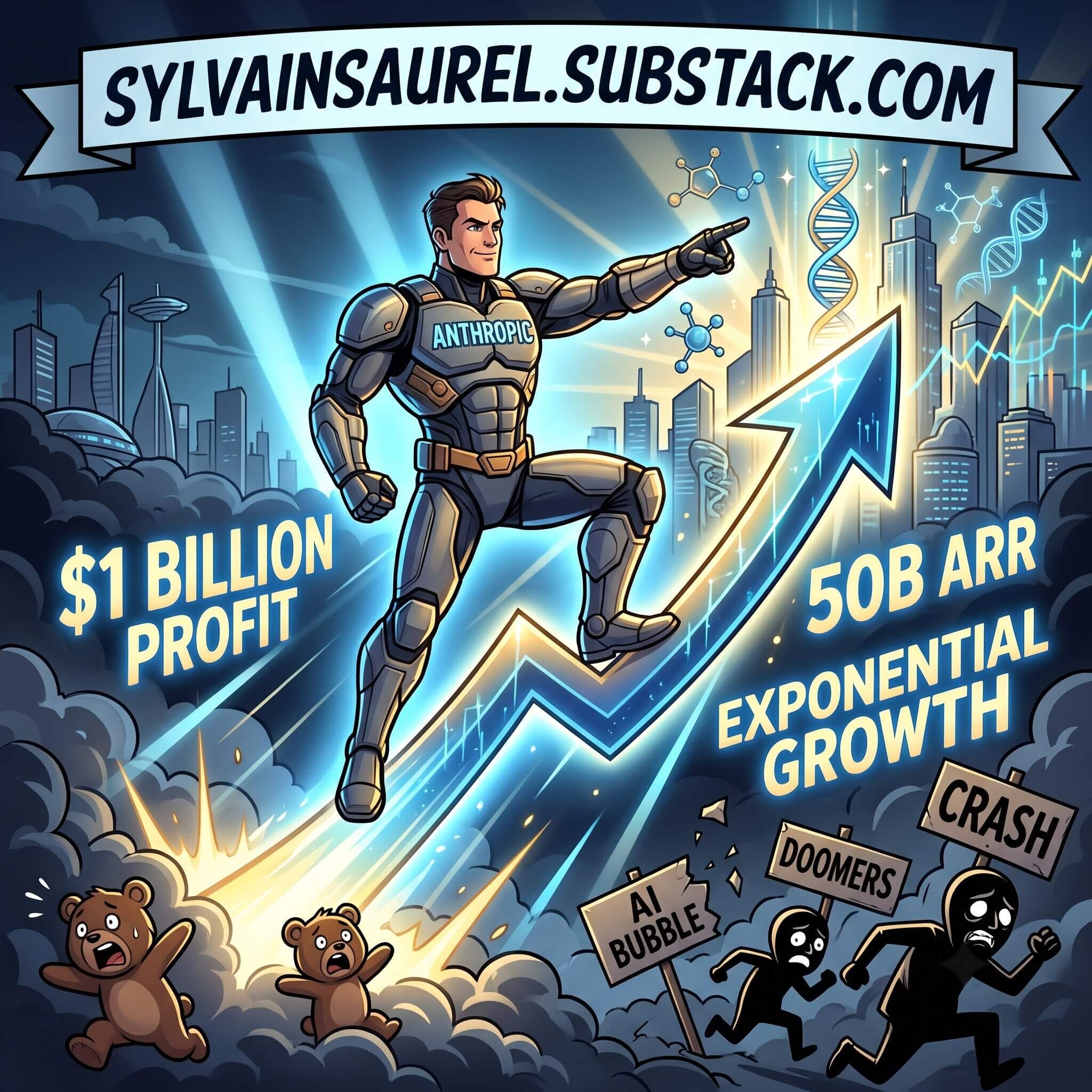
For the past three years, a persistent chorus of skeptics, short-sellers, and self-proclaimed industry Cassandras has dominated financial media with a singular, unyielding narrative: Artificial Intelligence is a bubble.
They pointed to the staggering capital expenditures required to build data centers. They highlighted the immense energy costs of training large language models. They drew ominous parallels to the dot-com crash of 2001, warning that the AI industry was destined for a catastrophic collapse, one that would make the Pets.com era look like a minor market correction. “The labs make no money,” the bears insisted. “The use cases are trivial. The unit economics are fundamentally broken.”
Today, that narrative lies in ruins.
In a staggering financial revelation that has sent shockwaves through Wall Street and Silicon Valley alike, Anthropic has reported $1 billion in pure profit in its latest quarter. This is not gross revenue. This is not a projected valuation based on speculative venture capital funding. This is $1 billion in cold, hard, bottom-line profit, driven by a blistering $50 billion Annual Recurring Revenue (ARR) run rate.
Anthropic has not merely survived the intense scrutiny of the AI bears; it has delivered a devastating, empirical blow to their core philosophy. By transforming exponential intelligence into exponential revenue, Anthropic has redefined the velocity of enterprise growth, proving that the human mind’s inability to grasp non-linear scaling is the only real bubble that burst today.
This is the story of how a company went from $100 million in revenue to a $50 billion juggernaut in under thirty months, why its profit margins are breaking economic models, and how its expansion into biology, materials science, and finance is setting the stage for a $400 billion future.
The Memory Wall: How the AI Revolution Became a Trillion-Dollar Memory Arms Race.

For the last fifty years, the story of computing was written almost entirely in the language of processing power. From the earliest silicon wafers to the massively parallel architectures of the early 2020s, the battle cry of the global technology sector was relentless and singular: build faster chips, shrink the transistors, and multiply the cores. Moore’s Law—the observation that the number of transistors in an integrated circuit doubles about every two years—was the drumbeat to which the entire digital economy marched. But as artificial intelligence evolves from a novel, experimental software category into the foundational infrastructure of the modern global economy, the narrative has violently and irreversibly shifted.
Part I: The Anatomy of the Bear Market Illusion
To understand the magnitude of Anthropic’s achievement, we must first dissect the arguments of the AI doomers. The pessimism was not entirely without a logical foundation; it was simply rooted in outdated, linear economic paradigms.
The 2001 Dot-Com Fallacy
The most common weapon in the bear’s arsenal was the historical analogy of the early 2000s internet bubble. During that era, telecommunications companies laid millions of miles of fiber-optic cables, and startups burned through billions in venture capital with no viable path to monetization. The infrastructure was built before the consumer demand or the software ecosystem existed to utilize it.
The bears applied this exact template to AI in 2023 and 2024. They saw tech giants hoarding GPUs, building massive server farms, and spending billions on compute and talent. Because early AI iterations—often glorified consumer chatbots—did not immediately generate enterprise-level ROI, the doomers concluded the infrastructure was a bridge to nowhere. They argued that AI labs were subsidized by venture capital and would eventually collapse under the weight of their own operating expenses.
The Myth of Broken Unit Economics
The second pillar of the doomer thesis was unit economics. Training a frontier model costs hundreds of millions of dollars. Serving that model (inference) requires massive, continuous computational power.
The Assumption: Bears assumed that inference costs would always outpace the price customers were willing to pay.
The Conclusion: Therefore, AI labs were selling dollar bills for ninety cents, artificially inflating adoption through subsidized pricing that would vanish once the VC money dried up.
What the skeptics failed to account for was the algorithmic efficiency curve and the compounding value of cognitive utility. They viewed AI as a traditional SaaS (Software as a Service) product, where margins are fixed, and scaling is linear. Anthropic, however, was not building software. It was synthesizing intelligence. And intelligence, once packaged and optimized, scales in a way that traditional software simply cannot.
Elon Musk's $2 Trillion Space Mirage: The Fatal Physics of Orbital AI.

In this month of July 2026, humanity finds itself at a technological crossroads. The frantic race toward Artificial General Intelligence (AGI) has triggered an unprecedented energy demand, pushing terrestrial infrastructure and capital expenditure limits to the breaking point.
Part II: The Impossible Ascent – A Timeline of Unprecedented Growth
No company in the history of global commerce—not Standard Oil, not Ford, not Apple, not Google—has scaled its revenue with the velocity Anthropic has demonstrated between 2024 and mid-2026. The trajectory defies traditional business physics. Let us examine the milestones of this unprecedented ascent.
The Baseline: 2024 ($100 Million Revenue)
In 2024, Anthropic was already recognized as a leader in safety-conscious, highly capable AI with its Claude model family. However, its revenue footprint was relatively modest at $100 million for the year.
At this stage, the company was primarily engaged in exploratory enterprise partnerships, API access for developers building early-stage wrappers, and consumer subscriptions. The $100 million figure was respectable for a startup, but to the doomers, it was proof positive of their thesis: The revenue does not justify the multi-billion-dollar valuation. They argued that the market for text generation had plateaued.
The Ignition: 2025 ($1 Billion Revenue)
Then came 2025, the year the enterprise awoke to the true capabilities of frontier models. Anthropic’s revenue did not merely double or triple; it exploded by a factor of 10x, reaching $1 billion.
