
Beyond the GPU: Why Optical Interconnects Are the Next Trillion-Dollar AI Hardware Bet.
How the shift from copper to light is rewiring hardware supply chains and transforming compute into the world's most valuable commodity.

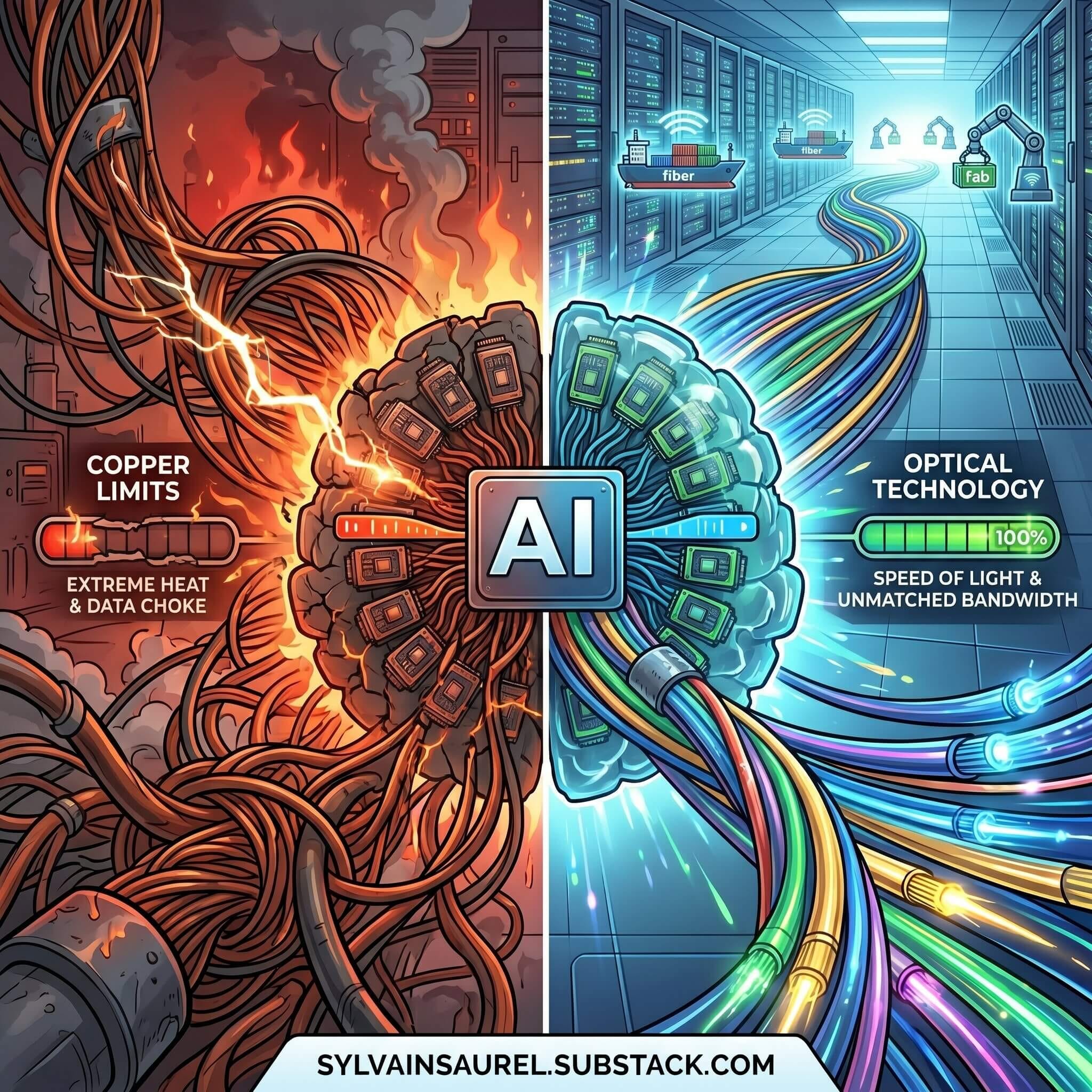
The artificial intelligence revolution has completely rewired the global technological landscape over the past two years. Trillions of dollars in market capitalization have been minted, largely concentrated in a specific sequence of hardware segments. First, the market relentlessly pursued Graphics Processing Units (GPUs), crowning companies like Nvidia as the undisputed kings of the AI gold rush. When the realization dawned that GPUs require massive, high-speed memory to operate at peak capacity, capital rotated toward High Bandwidth Memory (HBM) suppliers. More recently, as data center architectures matured to support complex end-to-end AI pipelines, we witnessed a resurgence of interest in advanced Central Processing Units (CPUs) that feed data into these accelerated systems.
But markets are forward-looking mechanisms, and the most astute investors and technologists are already asking the inevitable question: From GPUs, to memory, to CPUs—where is the next massive opportunity in the AI infrastructure supply chain?
The answer is not found in the processing chips themselves, but in the intricate web that binds them together. The next tremendous wave of technological advancement and wealth generation lies in the interconnect sector.
To understand why this is the case, we must fundamentally dismantle how we visualize artificial intelligence. We must stop looking at the individual chip and start looking at the entire ecosystem. We must look at the physics of data transfer, the staggering economics of power consumption, and the undeniable limitations of traditional materials. The transition from copper to optical interconnects is not just an upgrade; it is a physical imperative.
The Myth of the Solitary GPU
When the mainstream media discusses artificial intelligence, the imagery is often reduced to a single, monolithic chip—a gleaming piece of silicon, like an H100 or a B200, supposedly doing all the thinking on its own. This is a fundamental misunderstanding of how modern AI is trained and deployed.
A data center is not about a single GPU. It is not even about a hundred GPUs. The reality of modern compute—which is rapidly becoming the world’s most valuable commodity—is that a foundational model like GPT-4 or its successors cannot be trained on a single machine. The computational requirements are too vast, the parameter counts too high, and the datasets too unimaginably large.
Instead, an AI data center is a sprawling, interconnected beast comprising hundreds of thousands of GPUs working in parallel. These massive clusters operate under a distributed computing model. A single machine learning workload is split into thousands of micro-tasks, processed simultaneously across thousands of chips, and then stitched back together.
For this to work, the chips must communicate with each other continuously. They must share gradients, weights, and intermediate results. They must synchronize their operations down to the nanosecond. If one GPU finishes its calculation but has to wait for data from another GPU across the room, the entire system pauses. In the industry, this is known as “idle time,” and in the world of high-performance computing, idle time is the ultimate sin.
Therefore, the network is the computer. The speed of an AI cluster is entirely bottlenecked by the speed at which data can move between the chips. Supplying power and sharing data across these massive clusters is the definitive engineering challenge of our generation. And right now, that challenge is running headfirst into a wall made of copper.
The Copper Paradox: 30 Miles of Impending Bottleneck
Walk into a standard, state-of-the-art data center today, and you will be met with a deafening roar of cooling fans and a visual labyrinth of cables. In a normal, high-density AI data center, there are roughly 30 miles of copper wires connecting all the GPU racks together.
Take a moment to truly conceptualize that scale. Thirty miles of thick, heavy, insulated copper cabling weave through server racks, under raised floors, and across ceiling trays. These cables form the central nervous system of the AI cluster, primarily utilizing technologies like Direct Attach Copper (DAC) for short runs within a rack, or heavy Ethernet and InfiniBand cables spanning across the facility.
For decades, copper has been the undisputed champion of data transmission. It is relatively cheap, highly malleable, easy to terminate, and universally understood by engineers. But as the sheer volume of data required for AI scales into the petabytes per second, those 30 miles of copper wire create two catastrophic problems that threaten to halt the progress of AI scaling altogether.
Problem 1: The Speed Limit of Electrons
The first major issue is rooted purely in the laws of physics. Sending high-speed data through copper wires has insurmountable limits. When we transmit data over copper, we are essentially pushing electrical signals—a flow of free electrons—through a metal conductor.
