
AI: Devastating Bubble or Revolution of the Century? Why Nvidia's CEO is Betting $1 Trillion That You're Wrong.
While Wall Street fears a dot-com crash, Nvidia is laying the tracks for a new industrial era. Discover why AI's physical foundations will outlast the software hype.

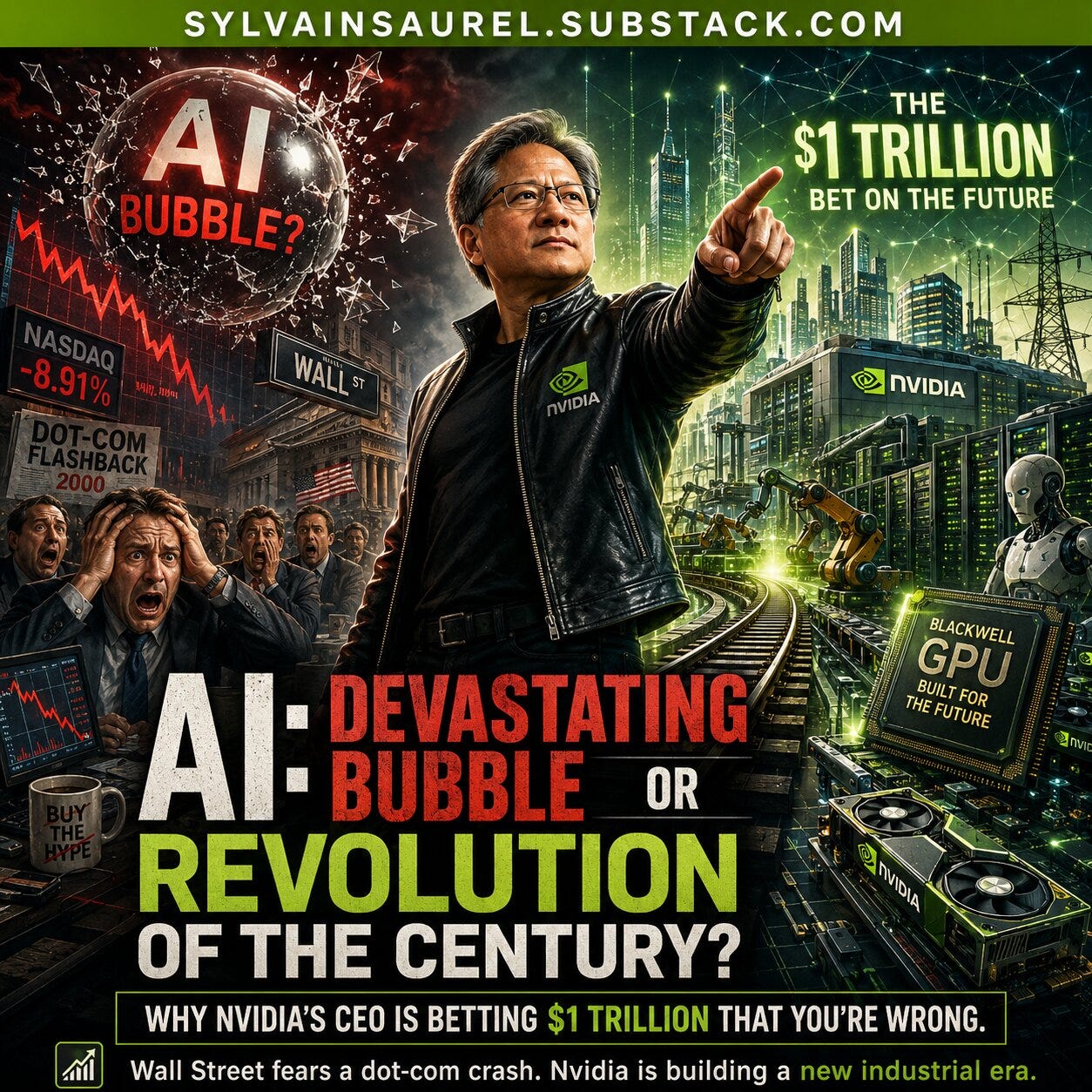
Is artificial intelligence just a financial flash in the pan or the foundation of a new industrial era?
While fears of a collapse similar to the dot-com bubble of the 2000s haunt the markets, Jensen Huang, the charismatic CEO of Nvidia, offers a radically different vision.
To him, we are not facing a speculative bubble, but rather the beginning of the greatest overhaul of computing infrastructure in human history.
For a few years now, the tech world has been living at the frantic pace of artificial intelligence. Hundreds of billions of dollars have been pumped into startups, data centers, and silicon chips. Companies across all sectors have promised productivity revolutions, launching dozens of products on the market meant to transform how we work, create, and live.
Yet, a sense of unease is setting in. The promised productivity gains are sometimes slow to materialize on financial balance sheets. Many CEOs, initially seduced by the siren song of generative AI, are quietly admitting that they are struggling to find a tangible return on investment (ROI). The fear of a gigantic speculative bubble—often described by analysts as potentially more devastating than the infamous dot-com crash of the late 1990s—is beginning to grip Wall Street. A brutal burst could vaporize hundreds of billions of dollars and drag the global economy into a recession.
Facing this rising tide of panic, one man stands with disconcerting serenity: Jensen Huang.
A visionary electrical engineer, founder, president, and CEO of Nvidia, Huang is not a mere observer; he is the primary hardware architect of this revolution. Under his leadership, Nvidia has transitioned from being a respected manufacturer of graphics cards for gamers to the undisputed titan of the global economy, crossing the dizzying $5 trillion market capitalization mark in October 2025.
When recently asked about this alleged “AI bubble,” Huang brushed the fears aside. His argument does not rely on blind optimism, but on cold, engineering-driven analysis.
Here is why the “King of AI” asserts that the current boom is here to stay.
The $800 Billion Tightrope: 5 Invisible Forces Controlling the Global Market.

Markets do not move in a vacuum; they are living, breathing ecosystems driven by human ambition, fear, and the relentless pursuit of yield.
1. The Genesis of a New Computing Paradigm
To understand Jensen Huang’s unwavering confidence, one must first understand the exact nature of what he is selling.
Initially, Nvidia specialized in graphics processing units (GPUs) to make video games smoother by massively parallel-processing thousands of simple operations. As it turned out, this computing architecture was exactly what artificial intelligence researchers needed to train deep neural networks. Nvidia anticipated this convergence, expanding its scope from entertainment computing to data science and, ultimately, generative AI.
During an interview with Mike Allen, co-founder of Axios, Huang delivered a key phrase to defuse the bubble theory:
“This time it’s different because demand is not the driver. The fact that demand is not the driver means this isn’t seasonal demand. The industry is the driver, which means the fundamental technology of computers is changing.”
For Huang, we are moving from the era of retrieving pre-existing information to the era of generating information in real-time. This shift requires computing power that traditional architectures simply cannot provide. It is a complete rebuild of the very foundations of computing.
2. Infrastructure as a Foundational Layer (The Railroad Metaphor)
The current disappointment among some CEOs regarding the lack of immediate ROI can be explained by a misunderstanding of the technological timeline.
Think of the railroad boom of the 19th century: immense capital was swallowed up to lay tracks across continents. For years, these investments led to nothing but massive expenses and bankruptcies. Yet, once the infrastructure was in place, it triggered an unprecedented industrial revolution. AI is currently exactly in this “track-laying” phase.
As early as January 2026, Jensen Huang reminded us that the technology platform is built in layers. The current malaise stems from the fact that the world expects the final layer (software applications) to immediately generate billions, while we are still pouring the concrete for the hardware foundations.
AI infrastructure requires colossal investments before it can produce intelligence on an industrial scale. This is why Huang estimates that the sector will need to grow five to ten times in size over the next decade.
The Story Behind the Hack: The Fall of the Bitcoin Citadel and the $88 Million Coldcard Catastrophe.

How a silent entropy bug, an open-source licensing war, and AI-driven code analysis shattered the illusion of flawless self-custody.
3. Debt, Hyperscalers, and Return on Investment
The question of how to finance this infrastructure is at the heart of the anxiety. Several major cloud providers (hyperscalers like Amazon, Microsoft, and Google) are taking on massive debt in the bond market to buy Nvidia’s precious GPUs.
Huang surprised many by stating that he was completely unconcerned about his clients going into debt. Why? Because the shift to AI represents a very long-term evolution. For Microsoft, Meta, or Amazon, failing to invest heavily in AI today poses an existential risk. The debt incurred today is the mandatory price of admission to survive in tomorrow’s economy.
Furthermore, Huang points out that AI is already generating profits for pioneering companies like Anthropic. We are reportedly at an “inflection point” where the adoption of autonomous AI agents is truly beginning to transform productivity.
4. When Scarcity Becomes an Economic Blessing
One of Jensen Huang’s most fascinating arguments concerns the constraints of the physical world. In a typical speculative bubble, capital flows freely, leading to massive overproduction (too many houses built, too much fiber optic cable laid), which then causes prices to collapse.
However, the rollout of AI is facing major bottlenecks:
Chip shortages: Manufacturing nanometric chips is incredibly complex.
Land and labor shortages: Building data centers requires time and specialized experts.
The power wall: Expansion is being held back by the capacity of electrical grids to supply the necessary gigawatts.
Far from complaining, Huang asserts:
“We are fundamentally constrained in every direction, in every way. That constraint is a good thing. It slows the system down. So it gives us plenty of time to build out this infrastructure.”
Physical constraints act as natural regulators. They prevent the market from overheating too quickly and transform a dangerous speculative spike into a steady, prolonged growth curve.
Too Big to Fail 2.0: The Financialization of AI.

There is a terrifying fragility built into the foundation of the modern financial system. We are currently living through one of the most spectacular, capital-intensive technological arms races in human history. Trillions of dollars are being marshaled, committed, and deployed based on a single, unwavering assumption
5. $1 Trillion: Outsized Ambition or Achievable Prophecy?
Despite this talk of needing to slow the system down, Jensen Huang literally stunned Wall Street at the GTC conference in March 2026. While the most optimistic estimates capped Nvidia’s future revenues around $500 billion, he announced that the company’s revenue could reach $1 trillion by 2027.
This dizzying projection relies on the insatiable demand for the new Blackwell and Vera Rubin chips, as well as the emergence of data center platforms as a new paradigm. Nvidia is no longer just selling components; it is selling the complete ecosystem of the digital future.
The Illusion of GDP: Why Economists Are Dead Wrong About China.

An observer reading the financial press in the West might assume the Chinese economy is perpetually teetering on the brink of total collapse. For years, American economists have published relentless warnings about China’s impending doom—citing local government debt, an over-leveraged real estate sector, demographic cliffs, and insufficient consumer spending.
Should We Take the King of AI at His Word? My Personal Take
To close out this reflection, I wanted to share with you, dear readers, my personal feelings on these staggering announcements.
After dissecting Jensen Huang’s arguments, one question inevitably lingers: is this discourse truly credible, or are we witnessing the PR masterpiece of a CEO trying to reassure his shareholders?
If you ask me whether I find Jensen Huang’s points valid, my answer is a definitive “yes,” but a “yes” that requires reading between the lines.
Fundamentally, his technological argument is irrefutable. Classical computing has hit a glass ceiling. For our machines to understand natural language, analyze images in real-time, or generate code, we have to change the engine. Accelerated computing is not a seasonal gadget; it is a physical necessity. In fact, I found his analysis on shortages (energy, components, land) to be particularly brilliant. As a market observer, I agree with his assessment: these physical constraints are our best safety net against industrial overheating. They spread the investment over time and prevent the kind of overproduction that has historically killed so many tech companies.
Similarly, I understand his composure regarding the colossal debt taken on by his clients like Microsoft or Google. For these giants, going into debt today to buy Nvidia chips is not a whim; it’s a matter of survival. Missing the AI turn means accepting obsolescence within ten years.
However, let’s keep our critical thinking intact. Jensen Huang remains the ultimate salesman for his own technology. Aiming for $1 trillion in revenue by 2027 is exactly the outsized ambition a CEO must project to justify a $5 trillion valuation. He is intentionally overlooking one major blind spot: Nvidia is not immune to economic gravity. If, tomorrow, the hyperscalers’ “AI agents” fail to find their market or generate the expected revenues to pay off this mountain of debt, the chip orders will stop dead in their tracks.
So, are we in a bubble? My diagnosis is that we are dealing with a hybrid phenomenon.
I believe we are experiencing an application bubble superimposed on a very real infrastructural revolution. Remember the 2000s: the dot-com bubble burst, thousands of startups went bankrupt, and investors were ruined. But the Internet didn’t disappear! The infrastructure, the submarine cables, and the protocols were still there, paving the way for the later emergence of the tech giants we know today.
In my eyes, this is exactly what is playing out with AI. The bubble will burst; that is a certainty, but the burst will be asymmetrical. It will hit full force the companies selling us miraculous “AI solutions” with no real business model, and those that took on too much debt without a clear strategy.
On the other hand, the infrastructure layer—the one Jensen Huang is building—will remain. As long as the world wants artificial intelligence, it will have to pass through Nvidia’s technological tollbooth.
And you, what do you think?
Do you believe Jensen Huang’s optimism is justified, or do you see the warning signs of an imminent crash?
Feel free to share your thoughts in the comments; the debate is more open than ever.
5.24%: The Number Terrifying the U.S. Treasury.

The foreign exchange market is often the theater of silent clashes. Still, occasionally, the tectonic plates of global finance begin to tremble with such violence that the shockwave propagates across all asset classes. What we have just witnessed with the spectacular rebound of the Japanese yen is not a simple technical correction or a fleeting tremor.
The 90% Shock: How America's Silicon Supremacy Just Ended the Global AI Race.

The global artificial intelligence race has entered a paradoxical phase. If you look purely at the volume of tokens flowing through the global economy today, you might conclude that China has already won. Chinese open-source models—most notably from labs like DeepSeek and Alibaba’s Qwen—have achieved a staggering feat
Deconstructing the Memory Stock Sell-Off—And the Generational Disconnect Between Narrative and Reality.

The financial markets are, at their core, a pendulum that swings violently between irrational exuberance and unfounded terror. Right now, in the semiconductor and memory sectors, we are witnessing the latter. Billions of dollars in market capitalization are being wiped out, retail investors are panic-selling, and institutional algorithms are triggering stop-losses based on a narrative that belongs in a science fiction novel, not a serious investment thesis.